All Categories
- ATEN
- EPSON
- HISENSE
-
AV Signal Distribution
In AV Signal Distribution
- JK
-
Screens
In Screens
-
Projector
-
Cables
In Cables
- DTECH
- Business
- VISION
-
Projector Bracket
In Projector Bracket
-
Digital Signage Solutions
In Digital Signage Solutions
Brands
-
Audio
In Audio






All Categories
- ATEN
- EPSON
- HISENSE
-
AV Signal Distribution
In AV Signal Distribution
- JK
-
Screens
In Screens
-
Projector
-
Cables
In Cables
- DTECH
- Business
- VISION
-
Projector Bracket
In Projector Bracket
-
Digital Signage Solutions
In Digital Signage Solutions
Brands
-
Audio
In Audio

BROWSE CATEGORIES
Help
AV Signal Distribution
Dtech Splitter, HDMI, 8 Port, 4K @30HZ – 7148B
R876.05
Eight-output HDMI splitter for signage, exhibition stands and classrooms: one source shown on eight screens, at up to 4K 30 Hz.
- 1 HDMI input, 8 HDMI outputs
- 4K at 30 Hz, 3D, CEC
- Input lead 5 m, output leads 10 m (26AWG)
- 5 V 2 A supply
- 225 x 63 x 15 mm, 340 g
- Brand :Dtech
- SKU :DTECH-7148B
- Category :AV Signal Distribution
- Availability :Out of Stock
Out of stock
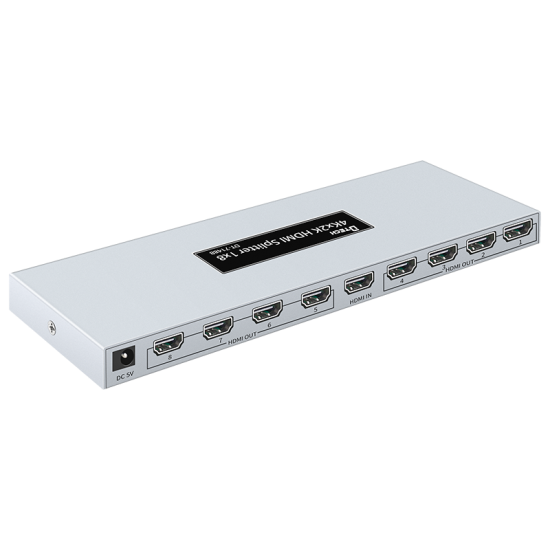
The Dtech DT-7148B (listed here as 7148B) feeds one HDMI source to eight displays from a single flat case, 225 x 63 x 15 mm and 340 g. It carries 4K at up to 30 Hz with 3D and CEC, and runs from a 5 V 2 A adapter. Plan around the input lead first: Dtech rates it for only 5 m, against 10 m for each of the eight outputs.
Placing the splitter: 5 m in, 10 m out
Both distances assume 26AWG HDMI cable. Put the 7148B beside the source, in the same cabinet or under the same desk, and spend the longer cable runs on the screen side. A display more than 10 m from the splitter needs an HDMI extender on its output.
All ten connections share one long edge. HDMI IN sits in the middle, outputs 5 to 8 run to its left with the DC 5V socket at the far end, and outputs 1 to 4 run to its right, so nine HDMI leads and the power lead leave from the same side. The rated input is 5 V 2 A, and the supplier notes for this model ask for the adapter delivered with it rather than a substitute.
4K at 30 Hz on all eight outputs
Dtech’s 340 MHz rating works out to 10.2 Gbps across HDMI’s three data channels, the bandwidth HDMI Licensing lists for 4K at 30 Hz. Eight TVs running the same advert, price list or presentation fit within that. A 4K computer desktop or a game at 30 Hz updates half as often as on a 60 Hz monitor, so for interactive content run the source at 1080p 60 Hz, or look at the four-output Dtech DT-7214, rated for 4K at 60 Hz.
HDCP and screens of different resolutions
No HDCP version appears in Dtech’s 7148B material, and HDCP 2.2 is not claimed, so treat protected 4K from a streaming player as unproven through this unit. Protected 1080p content is not restricted to HDCP 2.2 links.
The sheet also does not describe EDID handling and lists no scaler. All eight outputs carry the one format the source sends, whatever each screen can show.
Key specifications of the Dtech DT-7148B
| Inputs and outputs | 1 x HDMI in, 8 x HDMI out |
|---|---|
| Maximum format | 4K at 30 Hz, plus 3D |
| Bandwidth | 340 MHz / 3.4 Gbps per channel |
| Audio | Dolby TrueHD and DTS-HD over HBR, Dolby AC3, DTS, DSD, 7.1-channel LPCM |
| CEC | Supported |
| HDCP | Version not stated by Dtech |
| Rated input | 5 V 2 A |
| Reach on 26AWG cable | 5 m source to splitter, 10 m splitter to each screen |
| Dimensions | 225 x 63 x 15 mm |
| Weight | 340 g ± 10 g |
Questions about the Dtech DT-7148B
Can the 7148B feed eight screens at 4K 60 Hz?
No, it carries 4K at up to 30 Hz. Dtech moves 4K at 60 Hz over 18 Gbps in its HDMI 2.0 splitters, the DT-7212 for two screens and the DT-7214 for four, so eight screens at 4K 60 Hz means combining several of those.
What resolution should I set when the eight screens are different models?
The best mode the least capable screen supports, which is often 1080p when older sets are in the group. With no scaler in the splitter, a screen that cannot show the source format stays blank. The supplier notes for this model also say to set a resolution the splitter supports before connecting the input.
Can the source be more than 5 m from the splitter?
Not on 26AWG copper within Dtech’s rating, and Dtech gives no figure for other cable. Mount the splitter at the source and use the 10 m allowance on the outputs, or put an HDMI extender between a distant source and the input.
Will an AV receiver on one output get 7.1 sound?
The audio formats in Dtech’s sheet include Dolby TrueHD, DTS-HD and 7.1-channel LPCM, and the sound reaches every output with the picture. What the source actually sends depends on the display information it reads back, and Dtech does not say which of the eight outputs that comes from, so check on site.
You must be logged in to post a review.
You may also like these
Aten
 Low stock (1 left)
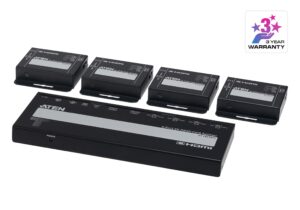
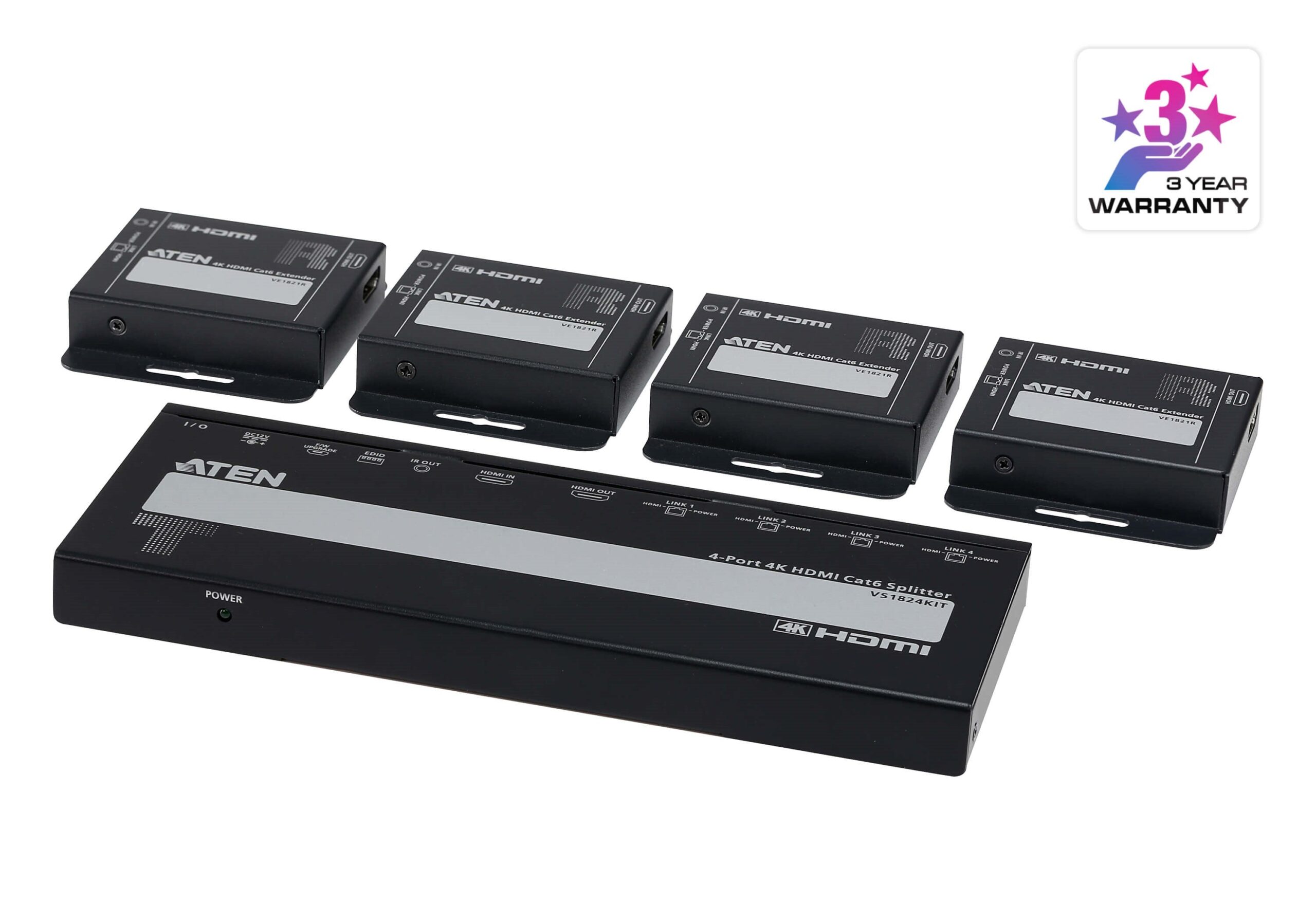
Aten 4K HDMI Cat6 Splitter with Receivers, 8-Port - VS1828KIT
R12,329.27
VS1828KIT Low stock (1 left)
Aten
Reviews
There are no reviews yet.