All Categories
- ATEN
- EPSON
- HISENSE
-
AV Signal Distribution
In AV Signal Distribution
- JK
-
Screens
In Screens
-
Projector
-
Cables
In Cables
- DTECH
- Business
- VISION
-
Projector Bracket
In Projector Bracket
-
Digital Signage Solutions
In Digital Signage Solutions
Brands
-
Audio
In Audio






All Categories
- ATEN
- EPSON
- HISENSE
-
AV Signal Distribution
In AV Signal Distribution
- JK
-
Screens
In Screens
-
Projector
-
Cables
In Cables
- DTECH
- Business
- VISION
-
Projector Bracket
In Projector Bracket
-
Digital Signage Solutions
In Digital Signage Solutions
Brands
-
Audio
In Audio

BROWSE CATEGORIES
Help
ALR
JK Hard Ambient Light Rejection Frame Screen, 120″, 16:9 Aspect Ratio – F9120ALR
R36,404.34
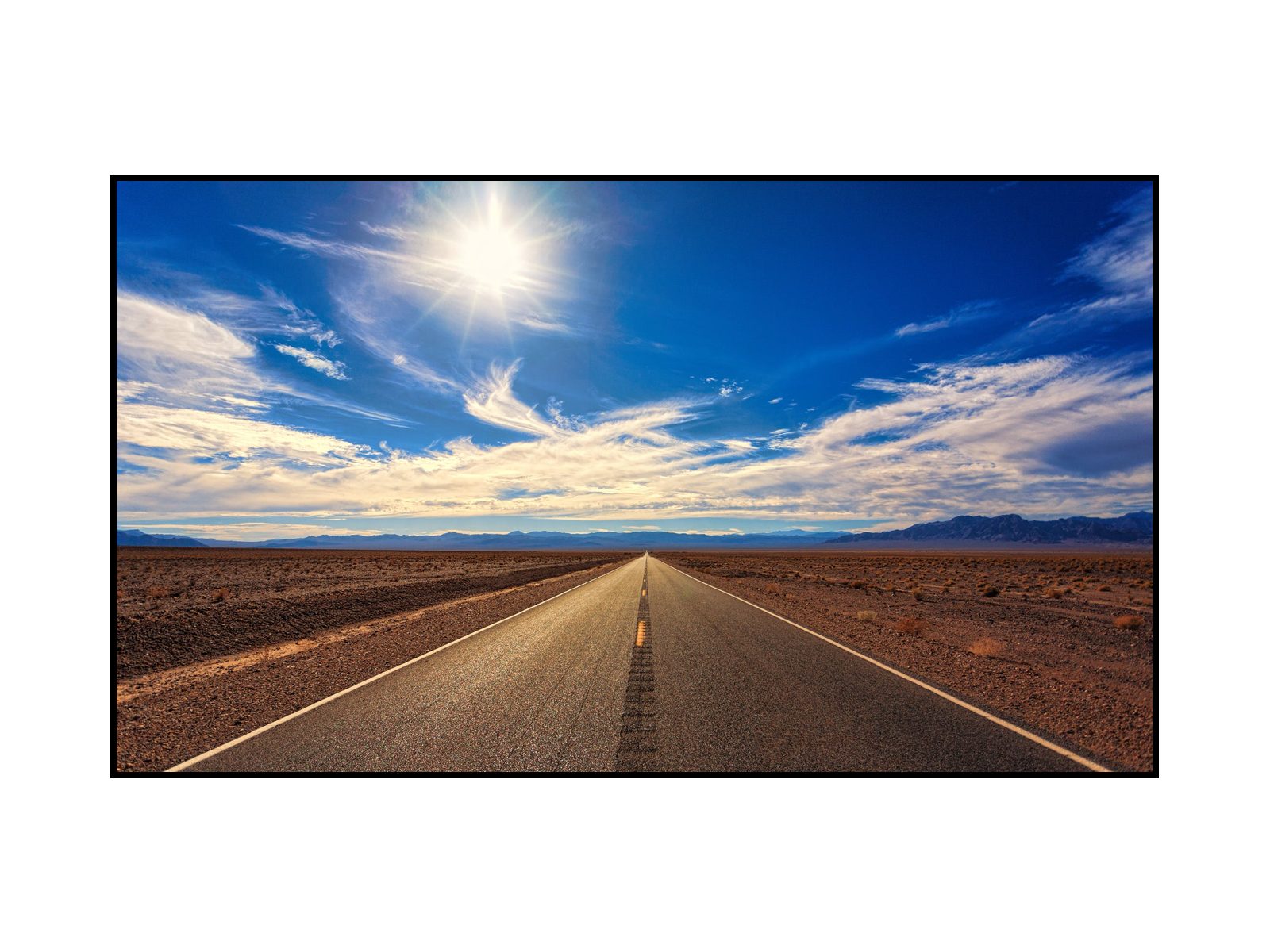
A 120" 16:9 hard ALR screen in a thin black frame, for rooms where the lights stay on.
- Image area 2660 x 1500 mm, overall 2684 x 1524 mm
- Absorbs light falling from above the screen
- For a ceiling-mounted laser or short-throw laser projector
- Not rated by JK for ultra short throw (UST) laser TVs
- Rigid panel, 47.5 kg net
- Brand :JK
- SKU :JK-F9120ALR
- Category :ALR
- Availability :
 In Stock
1 in stock
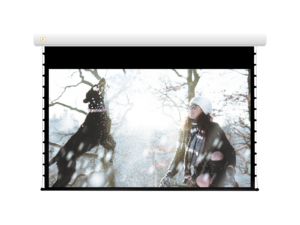
The JK F9120ALR is a 120″ (305 cm) 16:9 projection screen with a hard ambient light rejecting (ALR) surface in a fixed black frame, for rooms where daylight or room lighting stays on while the projector runs.
JK pairs it with laser projectors, short-throw laser models included, and draws the projector ceiling-mounted in front of the screen. JK does not rate it for ultra short throw (UST) laser TVs, so on that information it is not a screen to buy for one. It is also a rigid 47.5 kg panel.
Which projectors suit the F9120ALR
Beyond its one line of projector advice, JK’s sheet gives two diagrams. Both show the projector hanging from the ceiling in front of the screen, with light from fittings above the screen absorbed. The sheet names no optical type (angular reflective, lenticular or Fresnel) and gives no range of projection angles.
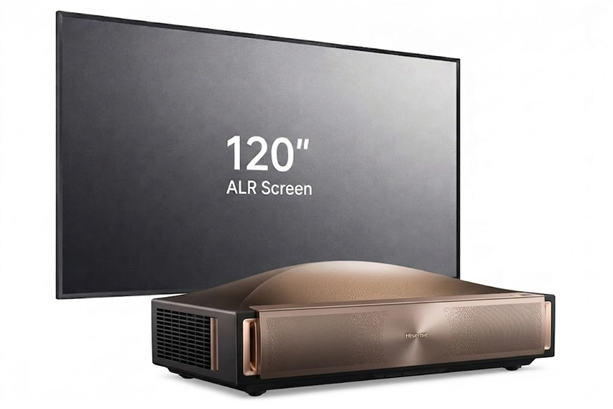
That gap matters because ALR screens are matched to a throw type. Lit from an angle its surface was not made for, an ALR screen rejects much of the projector’s own light along with the room light, and the picture looks dull. A UST projector sits just below the screen and fires steeply upwards, a direction JK’s sheet neither shows nor describes. For a UST laser TV, choose a screen its maker rates for UST projection, such as the Hisense DLT120C 120 inch ALR screen, which Hisense lists for UST projectors.
For a standard-throw pairing, the Epson EB-L530U laser projector (5,200 lumens) zooms between throw ratios of 1.35 and 2.20:1, which puts its lens roughly 3.6 to 5.9 m from this 2.66 m wide image. Its 1920 x 1200 panel is 16:10, so a 16:9 source fills the screen using 1920 x 1080 of it.
How the layered surface treats room light
JK describes a stack of layers: a highly reflective base that returns the projector’s light towards the audience, a micro-layered optical lens that absorbs light reaching the screen from above, and a diffusion layer that filters light from off-axis sources.
The screen performs best, JK says, when room light and projector light arrive from different directions. Ceiling downlights above the screen are the case its diagram shows being absorbed. A window or lamp behind the projector shines down the same path as the image, so expect less rejection of that light and plan blinds or switching for it.
Size, weight, handling and wall fixing
The frame takes the 2660 x 1500 mm image area to 2684 x 1524 mm overall, a black border of about 12 mm on each side. JK’s packed size of 2790 x 1690 x 80 mm is larger than the screen both ways, which points to delivery as one rigid panel rather than rolled. Packed, it weighs 109 kg, so check that doors, stairwells and lifts on the route can take a flat package that size.
The datasheet describes no wall brackets, fixings or cleaning method. At 47.5 kg across 2.68 m, the panel needs at least two people to lift and fixings rated for the wall it hangs on. Until JK’s care instructions are confirmed, carry it by the frame and keep fingers, solvents and spray cleaners off the micro-structured face that forms the image.
Key specifications of the JK F9120ALR
| Manufacturer model | JK-F9 120ALR |
|---|---|
| Diagonal | 120″ (305 cm) |
| Image area (W x H) | 2660 x 1500 mm |
| Format | 16:9 |
| Overall size (L x H) | 2684 x 1524 mm |
| Surface | Hard ALR: reflective base, micro-layered optical lens, diffusion layer |
| JK’s projector advice | Laser, including short-throw laser |
| Gain, half-gain angle | No figures from JK |
| Net weight | 47.5 kg |
| Packed size (L x W x H) | 2790 x 1690 x 80 mm |
| Packed weight | 109 kg |
Questions about the JK F9120ALR
Can I use the F9120ALR with an ultra short throw projector?
Not on JK’s information. JK does not rate it for UST projectors, and nothing on its sheet covers light arriving steeply from below, where a UST unit sits. If you already own a UST laser TV, look for a screen whose maker lists UST as its projection type.
Does the F9120ALR need a laser projector?
JK recommends one for the best image, but the datasheet does not say a lamp projector will fail on it. It gives no minimum brightness and no reason for the recommendation, so treat it as guidance rather than a requirement.
Can the projector hang from the ceiling with this screen?
Yes. A ceiling-mounted projector in front of the screen is the arrangement JK illustrates. JK gives no limit on how far above the image centre the lens may sit. Choose one of the projector ceiling brackets by checking its load rating and fixing pattern against your projector.
What gain and viewing angle does the JK F9120ALR have?
JK does not publish either figure. Its datasheet says the image is brightest on the centre line and dims gradually out to the half-gain angle, which JK calls very wide without giving degrees. If seats far to the side matter in your room, ask for the gain and half-gain figures before you commit.
Is there a 21:9 version of the F9120ALR?
Not of this rigid panel, on JK’s figures. The same datasheet lists a 120″ 21:9 ALR screen, the JK F9120ALRW, with a 2800 x 1200 mm image, 140 mm wider and 300 mm lower than this one. It weighs 14 kg net against 47.5 kg and packs into a 2920 x 290 x 150 mm carton, so it is built differently; our listing names it a soft ALR screen.
16:9
| Diag. Size (inch) | 100" |
|---|---|
| Viewing area W x H (mm) | 2220 x 1250 |
| Screen Length (mm) | 2244 |
| Screen Height (mm) | 1274 |
| Packaging Dimension L x W x H | 2380 x 1390 x 80 |
| Net Weight (kg) | 32 |
| Gross Weight (kg) | 75 |
| Manu Model # | JK-F9 100ALR |
You must be logged in to post a review.
You may also like these
JK
JK Electric Screen, 133", 16:9 Aspect Ratio, Matt White Fabric - E9133
R9,952.60
E9133 Out of Stock
Hisense
Low stock (1 left)
Hisense Ambient Light Rejection Frame Screen, 120", 16:9 Aspect Ratio - DLT120C
R23,160.91
DLT120C Low stock (1 left)
JK
In Stock
JK Electric Screen, 133", 16:10 Aspect Ratio, Matt White Fabric - E10133
R10,059.72
E10133 In Stock
JK
In Stock
JK Fixed Thin Frame Screen, 119", 16:9 Aspect Ratio, Matt White Fabric - F9119TF
R10,435.81
F9119TF In Stock
Hisense
Low stock (1 left)
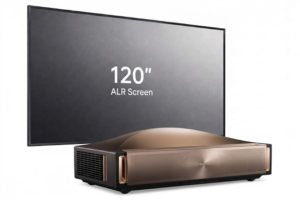
Hisense Laser Projection TV, 5000 Ansi Lumens, 4K resolution, UST, Incl 120" ALR - 120L9Q
R102,585.45
120L9Q Low stock (1 left)

Reviews
There are no reviews yet.