All Categories
- ATEN
- EPSON
- HISENSE
-
AV Signal Distribution
In AV Signal Distribution
- JK
-
Screens
In Screens
-
Projector
-
Cables
In Cables
- DTECH
- Business
- VISION
-
Projector Bracket
In Projector Bracket
-
Digital Signage Solutions
In Digital Signage Solutions
Brands
-
Audio
In Audio














All Categories
- ATEN
- EPSON
- HISENSE
-
AV Signal Distribution
In AV Signal Distribution
- JK
-
Screens
In Screens
-
Projector
-
Cables
In Cables
- DTECH
- Business
- VISION
-
Projector Bracket
In Projector Bracket
-
Digital Signage Solutions
In Digital Signage Solutions
Brands
-
Audio
In Audio

BROWSE CATEGORIES
Help
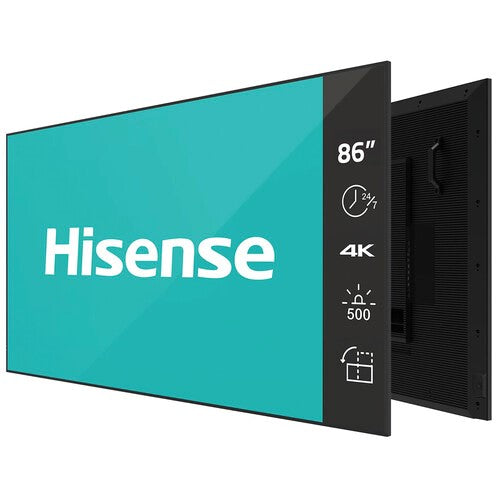
Digital Signage 24x7
Hisense Digital Signage 86″, 500 nits, 4k resolution, with 7day x 24hrs operation, Android 14 – 86DM66GE
R46,308.65
Hisense's 86 inch 4K display for round-the-clock signage in atriums, large receptions and conference foyers, with an Android 14 player inside.
- Largest DM66GE with an IPS panel: 500 nits, 25% haze
- 38.2 kg, VESA 600 x 400 mm, rear carry handles
- HDMI 2.1, USB-C with 65 W charging, HDMI eARC
- Failover input switching and timed on/off
- Brand :Hisense
- SKU :HISENSE-86DM66GE
- Category :Digital Signage 24x7
- Availability :
 In Stock
2 in stock
The Hisense 86DM66GE is an 86″ (217 cm visible) 4K signage display rated for continuous 24/7 duty at 500 nits. It is the largest DM66GE on the series’ IPS panel; the 100 inch model moves to VA.
At 38.2 kg, with mounting holes 600 x 400 mm apart, it fits an atrium wall, a large reception or a conference foyer where people read the screen from across the space, and its built-in Android 14 player means no PC behind it.
Picture size and reading distance across an atrium
Hisense’s manual puts the visible diagonal at 217 cm, giving an image close to 1.89 m wide and 1.06 m high. Its 3840 x 2160 pixels are each about 0.49 mm wide, so a viewer with 6/6 sight no longer resolves them from roughly 1.7 m.
Bezels are 10.8 mm at the top and sides and 11.8 mm at the bottom. In portrait the set becomes 1,097 mm wide and 1,927.6 mm tall, close to two metres, so check ceiling height and the mount position before choosing that orientation. The 178° viewing angles suit a wall that people also see from balconies or stairs.
Getting an 86 inch panel in and onto the wall
The carton is 2,117 mm long, 1,298 mm high and 269 mm deep and weighs 59.5 kg, so measure lift cars, stair turns and doorways on the route first. Out of the box the display weighs 38.2 kg, with rear handles that take its depth from 65 mm to 90 mm.
Four M6 screws go into the 600 x 400 mm holes and must engage between 12.0 and 13.0 mm into the rear shell; Hisense warns that longer screws cause irreparable damage. Fix to brick or concrete with anchors that each hold more than 12.7 kg (one third of 38.2 kg); a plasterboard wall needs reinforcing first. Hisense’s manual names its LG60060BE bracket for the 86 inch, lets the panel lean forward by as much as 15° when it hangs in landscape, and calls for 10 cm of ventilation space round the set.
The Vision VFM-W8X6 heavy-duty wall mount is rated for 47 to 100 inch screens and 130 kg, lists 600 x 400 mm, and holds the display 36 mm off the wall. To move the screen between halls, Hisense lists DM Series displays up to 86 inches for its WH3315 mobile stand, which carries 100 kg.
Control and sound when the screen hangs high
The supplied remote works up to 8 m in front of the screen and within 30° either side at 6 m. Beyond that range, plug an external IR receiver into the 2.5 mm IR input, or control the screen over RS232 on its 3.5 mm in and out jacks, over the LAN port, or through VisionInfo.
Each internal speaker is rated at 10 W, the same as on the 43 to 75 inch models. The Sound menu sends audio to one output at a time: the speakers, HDMI eARC on the HDMI 2 input, a Bluetooth device, USB sound equipment or the 3.5 mm output. In a large hard-surfaced space, eARC or the 3.5 mm output into the building’s sound system is the practical route.
Changes from the 86DM66D
The Hisense 86DM66D has the same 38.2 kg weight, 600 x 400 mm hole pattern, 500-nit brightness and 1,200:1 contrast. The GE moves from Android 11 to Android 14 and from a Cortex-A55 with 3 GB to a Cortex-A73 with 4 GB. It adds Wi-Fi 6, Bluetooth 5.4, an HDMI 2.1 input and a USB-C port with 65 W charging, and it drops the DisplayPort 1.2a input. Serial control moves from an RJ45 socket to 3.5 mm jacks, and Hisense’s maximum power figure rises from 325 W to 430 W.
86DM66GE specifications at a glance
| Size | 86″ (217 cm visible) |
|---|---|
| Net weight | 38.2 kg |
| Native resolution | 3840 x 2160, 60 Hz |
| VESA | 600 x 400 mm, M6 fixings |
| Brightness (typical) | 500 nits |
| Dimensions | 1,927.6 mm x 1,097 mm x 64.6 mm |
| Duty rating | 7 Day x 24 Hour |
| Packed weight | 59.5 kg |
| Contrast ratio | 1,200:1 |
| Maximum consumption | 430 W |
| Audio outputs | HDMI eARC, 3.5 mm, Bluetooth |
| Operating system | Android 14 with VisionInfo |
Questions about the Hisense 86DM66GE
Can several 86DM66GE screens be tiled into a video wall?
Yes, but the joins will show. The Multi-screen display setting splits one image over a grid of up to 15 rows and 15 columns, yet two 86DM66GE screens side by side leave about 21.6 mm of black frame between their pictures. Where the seams matter, use dedicated 24/7 video wall panels.
Can it pass its picture to a second screen across the foyer?
Yes, for two of its inputs. Its HDMI output carries the signal from the HDMI 3 input or the USB-C port, so a player or laptop connected there can feed a second display. Hisense does not list the internal Android player as a source for that output, so to show VisionInfo content on two screens, run the CMS on both. For a long run to the second screen, look at HDMI fibre cables.
What happens if the media player’s HDMI signal drops?
With Failover switched on (it is off by default), the 86DM66GE moves to the backup source you chose, such as a second HDMI input. When the main source returns, it switches back automatically. If both sources are lost, it shows its no-signal screen.
Can the 86DM66GE go on a mobile trolley instead of a wall?
Yes, on a stand rated for the load. At 38.2 kg it sits well inside the WH3315’s 100 kg rating, and its 600 x 400 mm holes fall within that stand’s VESA range of up to 1,000 x 600 mm. Lock the castors before anyone works on the screen.
Which accessories come with it?
Hisense’s datasheet lists the remote with its batteries, a mains lead, a quick setup guide and the converter cable that adapts the 3.5 mm RS232 jack. Its manual calls that converter cable optional and says the mains lead depends on the country. Brackets and trolleys are extra.
You must be logged in to post a review.
You may also like these
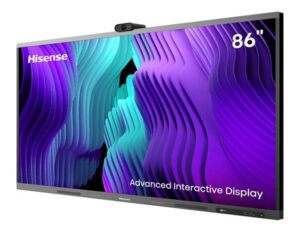
Hisense
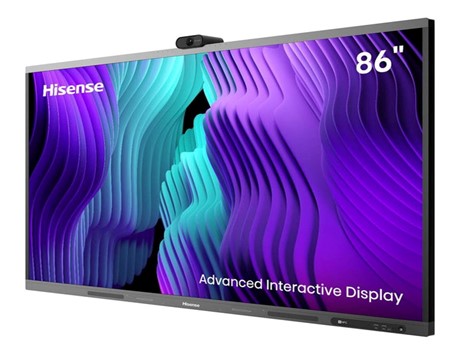
Hisense Interactive Panel, 86", 4k resolution, 400 nits, Android 13.0 - 86WM6FE
R69,731.61
86WM6FE Out of Stock
Hisense
Hisense Sound Bar, Bluetooth, 540W 5.1 Channel with Wireless Subwoofer - HS5100
R3,812.83
HS5100 Out of Stock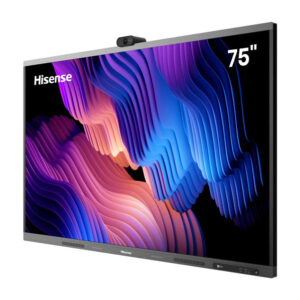
Hisense
Hisense Interactive Panel, 75", 4k resolution, 400 nits, Android 16.0 - 75WM6FEA
R56,599.85
75WM6FEA Out of Stock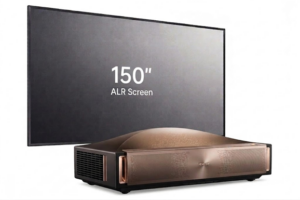
Hisense
Hisense Laser Projection TV, 5000 Ansi Lumens, 4K resolution, UST, Incl 150" ALR - 150L9Q
R143,619.63
150L9Q Out of Stock
Hisense
Reviews
There are no reviews yet.