All Categories
- ATEN
- EPSON
- HISENSE
-
AV Signal Distribution
In AV Signal Distribution
- JK
-
Screens
In Screens
-
Projector
-
Cables
In Cables
- DTECH
- Business
- VISION
-
Projector Bracket
In Projector Bracket
-
Digital Signage Solutions
In Digital Signage Solutions
Brands
-
Audio
In Audio














All Categories
- ATEN
- EPSON
- HISENSE
-
AV Signal Distribution
In AV Signal Distribution
- JK
-
Screens
In Screens
-
Projector
-
Cables
In Cables
- DTECH
- Business
- VISION
-
Projector Bracket
In Projector Bracket
-
Digital Signage Solutions
In Digital Signage Solutions
Brands
-
Audio
In Audio

BROWSE CATEGORIES
Help
Amplifier
Aten Amplifier, 2 X 60W – AP206
R18,595.50
The smaller of Aten's two-channel DSP amplifiers, for one zone of ceiling speakers or a stereo pair of 4 Ω loads.
- 60 W RMS per channel at 4 Ω; 120 W RMS on one bridged 70 V or 100 V line
- DSP set over the LAN; presets export to other units
- Takes the AP901 Dante or AP902 mic/line card
- No fan; rack and surface kit in the box
- Brand :Aten
- SKU :ATEN-AP206
- Category :Amplifier
- Availability :
 In Stock
1 in stock
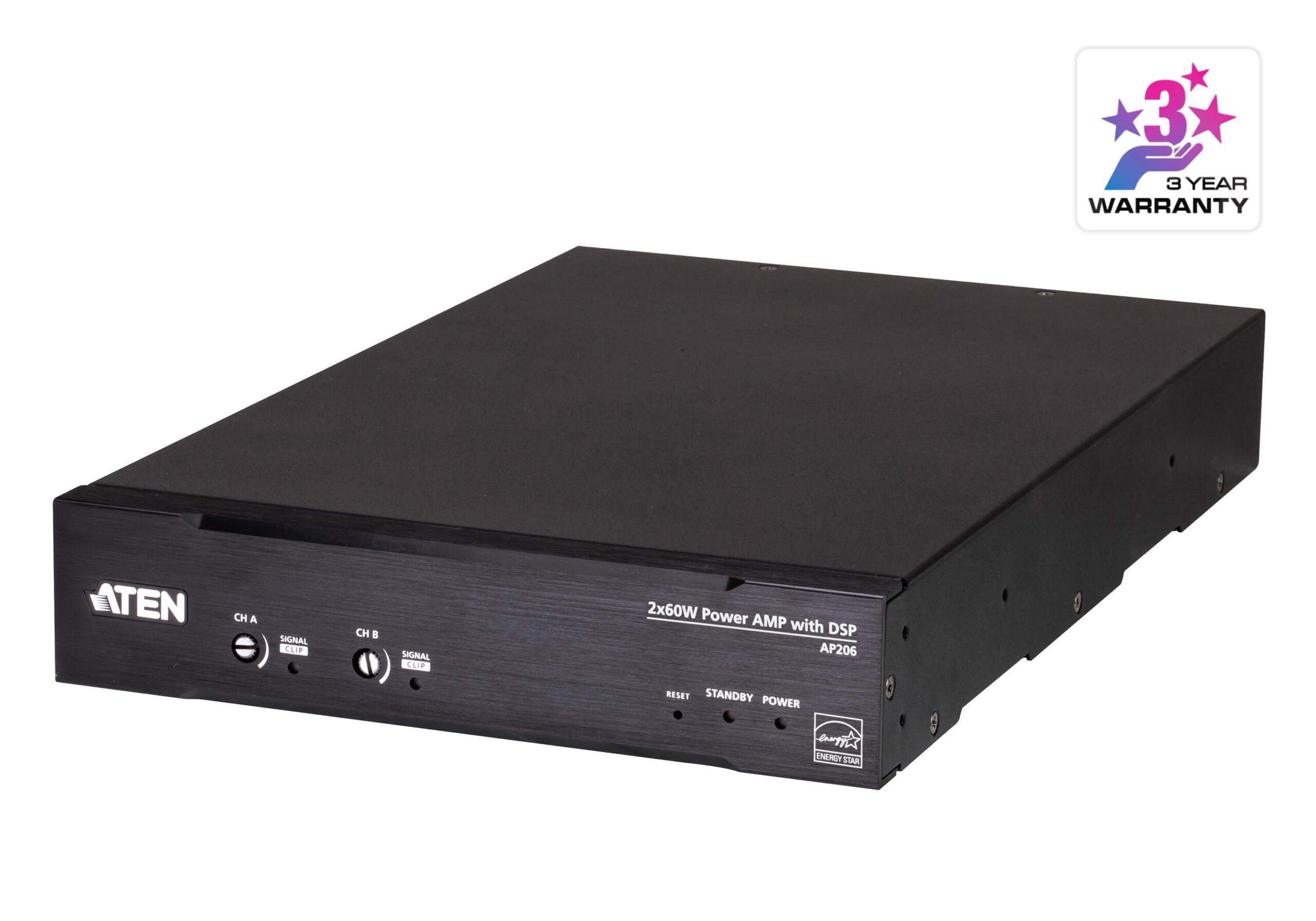
The Aten AP206 is a two-channel Class D amplifier rated at 60 W RMS per channel into 4 Ω, or 120 W RMS bridged onto a 70 V or 100 V speaker line. It shares its chassis, network-set DSP and expansion slot with the Aten AP212, which has twice the output. One AP206 runs eight AS106 ceiling speakers on 15 W taps, or a stereo pair of 4 Ω loads.
Stereo at 4 Ω, or one bridged line at 70 V or 100 V
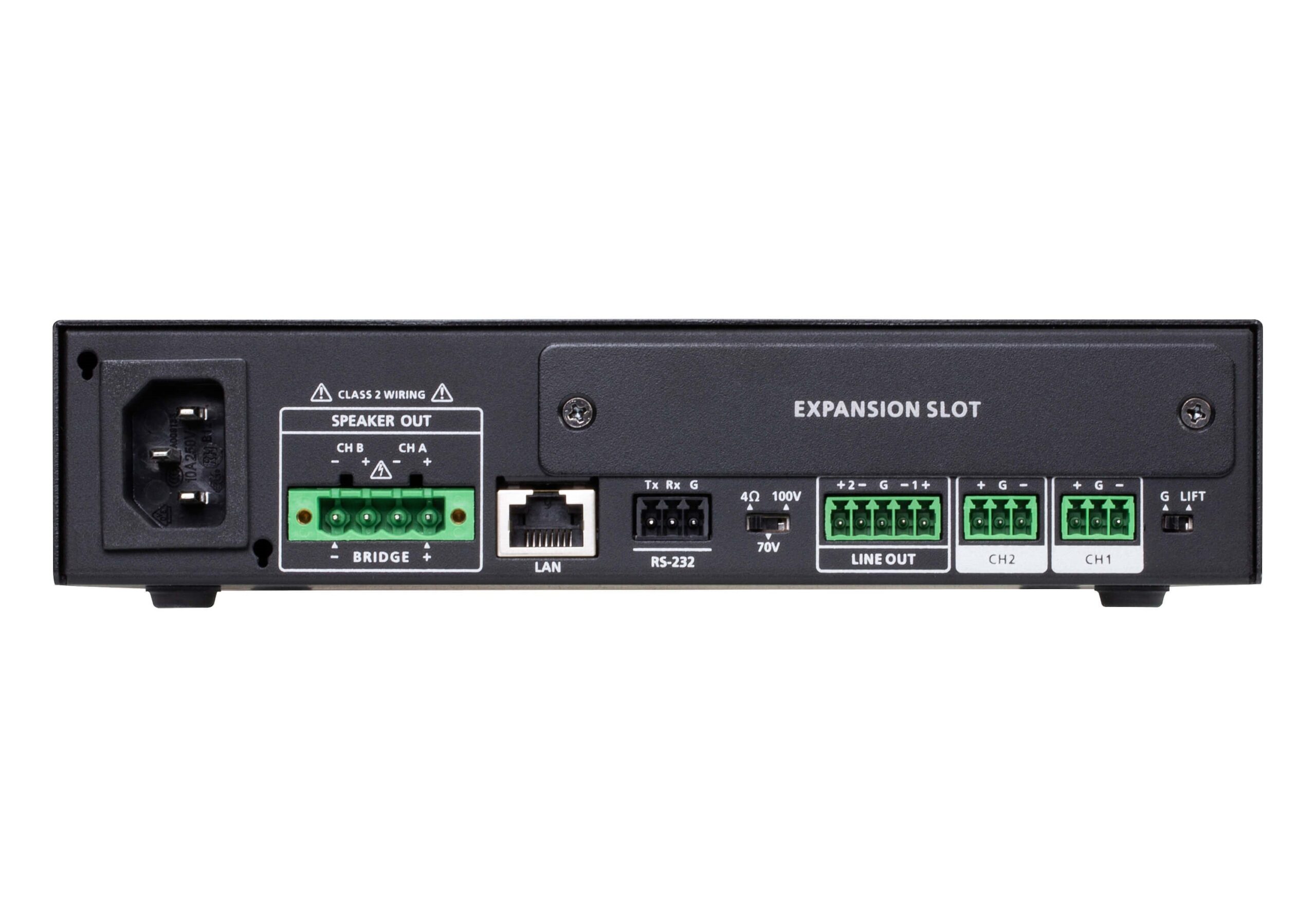
The impedance switch on the back has three positions. At 4 Ω the AP206 is a stereo amplifier: each channel drives a single 4 Ω speaker, or a parallel pair of 8 Ω speakers, at up to 60 W RMS (120 W peak). In the 70 V and 100 V positions the two channels join into one output of 120 W RMS (240 W peak) on the outer pair of speaker terminals. Aten rates that output at 40 Ω on 70 V and 80 Ω on 100 V, so keep the taps on the line to 120 W in total. A line that needs more belongs on the AP212.
What one AP206 can power with Aten AS104 and AS106 speakers
Bridged, using the full 120 W:
- Aten AS106 6.5″ ceiling speakers: 2 on the 60 W tap, 4 on 30 W or 8 on 15 W
- Aten AS104 4″ ceiling speakers: 6 on the 20 W tap, 12 on 10 W or 24 on 5 W
In stereo, a pair of AS104s set to 8R on each channel lands at about 30 W per speaker, the AS104’s RMS rating. Each model has a preset in the AP206’s speaker list that applies Aten’s tuning for it.
Setting up one room and copying it to the next
Configuration runs over the LAN port, in a web browser (at 192.168.0.60 unless a DHCP server assigns an address) or in Aten’s Audio Wizard application. Each speaker channel has input mixing, a speaker preset or filter, EQ, delay and a limiter. The two channels can be linked so an EQ or delay change on one copies to the other, and their faders can be grouped.
Up to 20 presets can be saved, exported as a .bin file and imported into another unit when several rooms share one design. A Test tab plays pink noise and 200 Hz, 1 kHz and 15 kHz tones for level checks, and a Diagnostic tab reports thermal, power-supply and amplifier status and exports an event log.
Adding Dante, microphones or a subwoofer
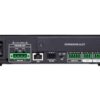
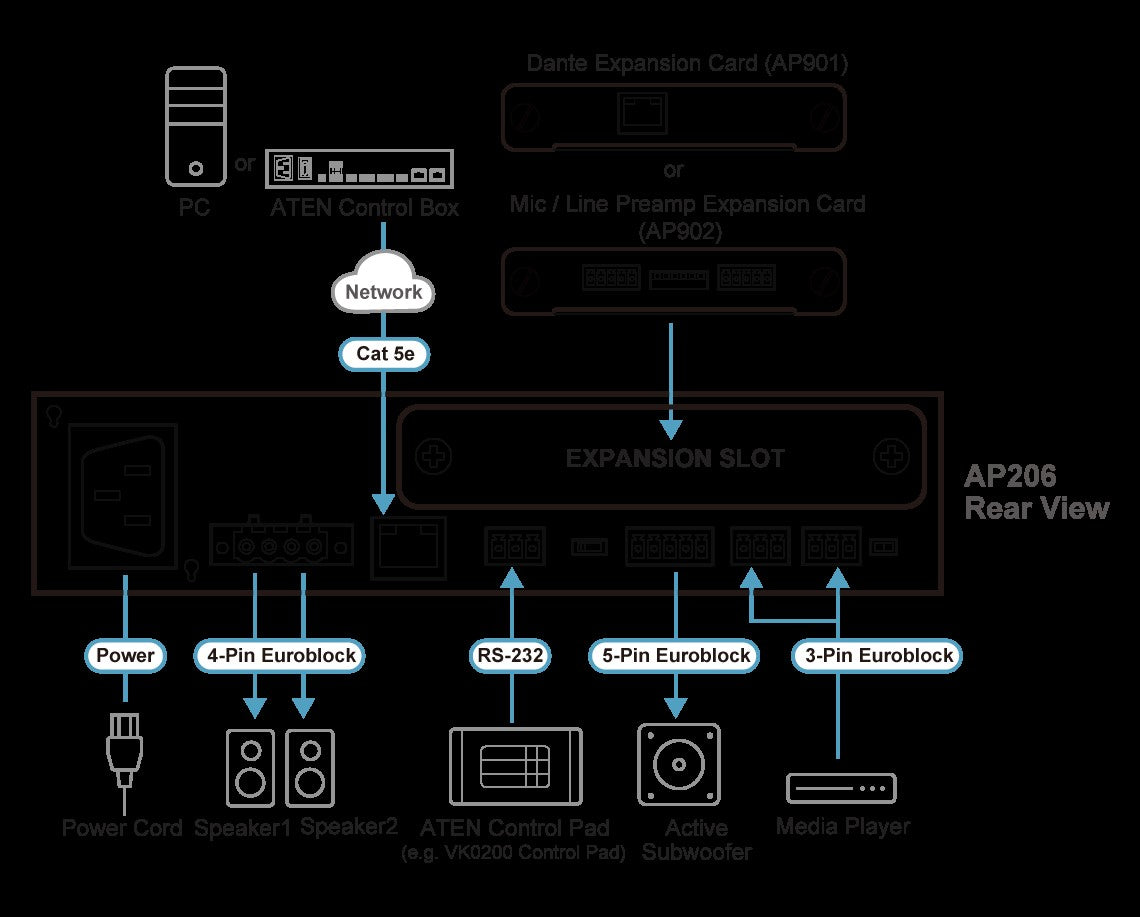
Out of the box, sources connect to two 3-pin Euroblock line inputs for balanced (+4 dBu) or unbalanced (-10 dBV) signals. The single expansion slot takes either the Aten AP901 Dante card, for two channels of network audio, or the AP902 for two microphone or line inputs; both are sold separately. The 5-pin line output can feed an active subwoofer or a second amplifier through a low-pass filter at 150 or 200 Hz, with its own delay.
Mounting and power
The box holds a rack and surface mounting kit, four foot pads for shelf use, Euroblock plugs for every connector and a power cord. There is no fan; the AP206 mutes itself when the heat sink runs too hot. It draws 18 W at 220 V at one-eighth output, and after power-up it waits in network standby until the input rises above -24 dBu or someone logs in.
Key specifications of the Aten AP206
| Rated output per channel, 4 Ω | 60 W RMS (120 W peak) |
|---|---|
| Rated output bridged, 70 V or 100 V | 120 W RMS (240 W peak) |
| Hi-Z rated load | 70 V: 40 Ω; 100 V: 80 Ω |
| Amplifier class | Class D, fanless |
| Frequency range | ±3 dB from 50 Hz to 20 kHz (4 Ω, 1 W) |
| Line inputs | Two, balanced +4 dBu or unbalanced -10 dBV |
| Expansion | One slot for AP901 (Dante) or AP902 (mic/line) |
| Network and serial | RJ45 LAN; RS-232 on 3-pin terminal, 19200 baud |
| Weight, dimensions | 2.15 kg; 20 x 32.3 x 4.4 cm |
| Power input | 100 to 240 V, 50/60 Hz, 2 A, PFC |
Questions about the Aten AP206
Can the AP206 run two separate 70 V zones?
No. The 70 V and 100 V settings work by bridging the two channels into one output, so one AP206 feeds one distributed line. A second constant-voltage zone needs another amplifier, such as a second AP206 or the mono Aten AP106.
Can I control the AP206 from a wall keypad?
Yes, through Aten’s VK control system. A pad such as the Aten VK0200 wires to the 3-pin RS-232 port, while the VK1100A and VK2100A control boxes reach it over the LAN. Aten lists all three, and the VK0100 pad, as compatible with the AP206.
Will the AP206 run on South African mains?
Yes. It accepts 100 to 240 V at 50 or 60 Hz, which covers a 230 V supply, through a standard IEC inlet on the back. Aten lists a power cord in the box without naming its plug, so a local IEC cord is the fallback if the plug does not suit your sockets.
Is the DSP built into every AP206?
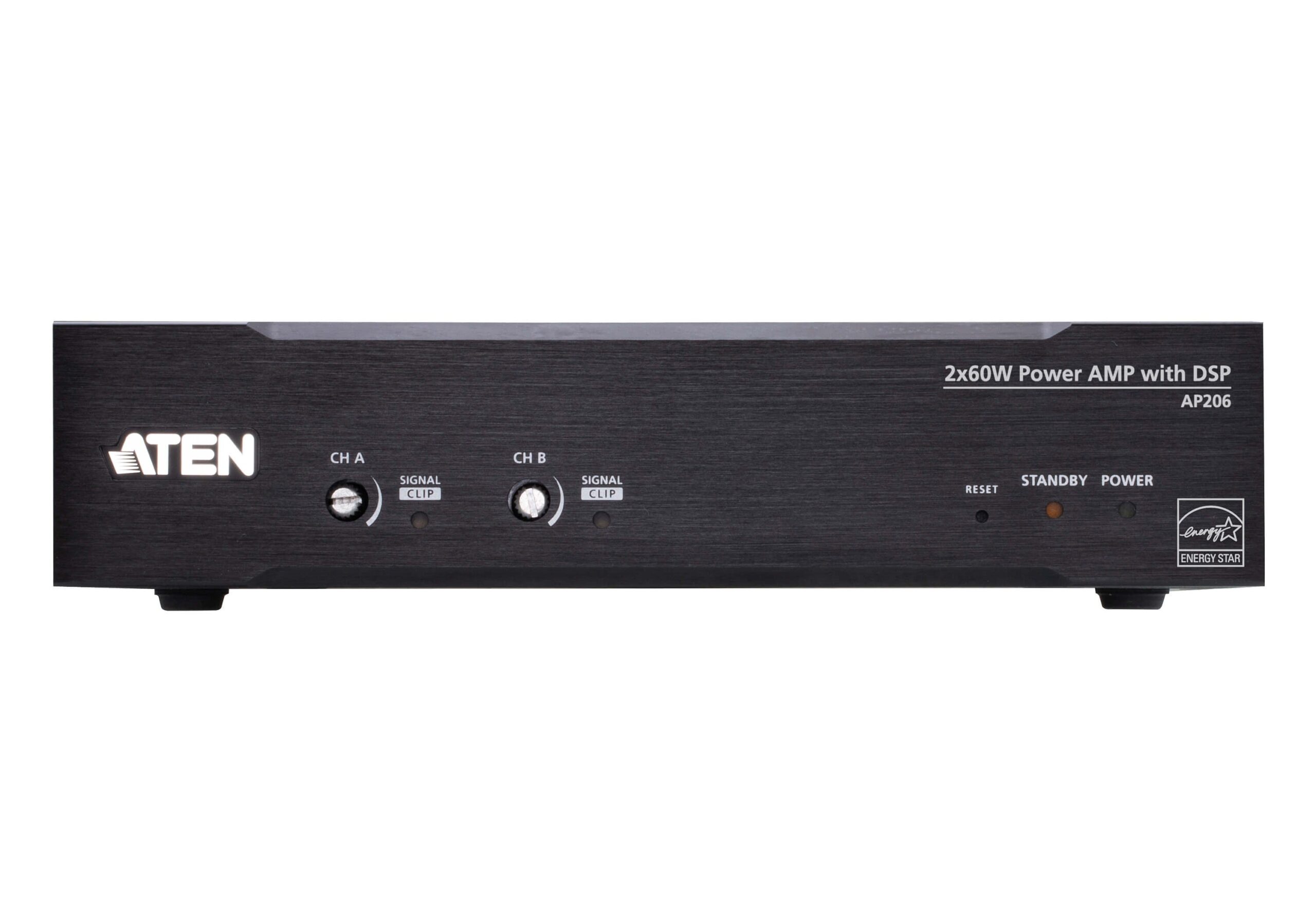
Yes. Aten sells the AP206 only as the 2 x 60W Power Amplifier with DSP. Presets, EQ, delay and limiter are reached over the network; the front panel carries only the two channel volume knobs, signal and status LEDs and a reset button.
System Specification
| Rated Power | 60Wrms / 120Wpeak per Channel @4Ω 120Wrms / 240Wpeak @70/100V Under Bridge Mode |
|---|---|
| Distortion | THD+N: |
| Frequency Response | 50~20kHz, +/-3dB @4Ω, 1W |
| Sensitivity | Balanced: +4dBu Unbalanced: -10dBV (0dBu=0.775Vrms, 0dBV=1Vrms) |
| Amplifier Type | Class D |
Audio Inputs
| Interfaces | 2 x 3-pin 3.5mm Euroblock (Bal/Unbal Line In) |
|---|---|
| Impedance | Balanced: 20kΩ / Unbalanced: 10kΩ |
| Detect Threshold | 50dBu |
Audio Outputs
| Interfaces | Line Output: 1 x 5-pin 3.5mm Euroblock Speaker Output: 1 x 4-pin 5.08mm Euroblock |
|---|---|
| Impedance | Lo-Z: 4Ω / Hi-Z: 70V (40Ω), 100V (80Ω) Line Output: 600Ω |
| Audio Effects | Built-In DSP |
| Protection | Output Shortcut AMP Output over/under voltage High Frequency Overload Thermal Protect |
Communication
| RS-232 | Connector: 3-pin, 3.5mm, Terminal Block Baud rate and protocol: Baud Rate: 19200, Data Bits: 8, Stop Bits:1, Parity: No, Flow Control: No |
|---|
Power
| Power Consumption | 100-240V~, 50/60Hz, 2A with PFC |
|---|
Compliance
| Certification | FCC, CE, UKCA |
|---|
Environmental
| Operating Temperature | 0~50℃ |
|---|---|
| Humidity | 0-80% RH, Non-Condensing |
| Storage Temperature | 20~60℃ |
Physical Properties
| Weight | 2.15 kg ( 4.74 lb ) |
|---|---|
| Housing | Metal |
| Dimensions (L x W x H) | 20.00 x 32.30 x 4.40 cm (7.87 x 12.72 x 1.73 in.) |
You must be logged in to post a review.
AP206 Datasheet PDF
You may also like these
Hisense
Reviews
There are no reviews yet.